Hand rankings
The list above, with kickers and ties.
Read →BEGINNER PILLAR · UPDATED 6 SEPTEMBER 2026
Texas Hold’em is a community-card game. You get two private cards. Five public cards can come out. You make the best five-card poker hand — or you win earlier if everyone else folds.
A hand runs preflop, flop, turn, river. Forced bets (blinds) start the pot. You can fold, check, call, bet, or raise on each street. Showdown only happens if two or more players are still in after the river.
Memorize this order before you worry about strategy. A longer ranking guide lives at poker hand rankings. Suit does not beat suit.
Blinds in more detail: blinds and antes. Who acts when: positions.
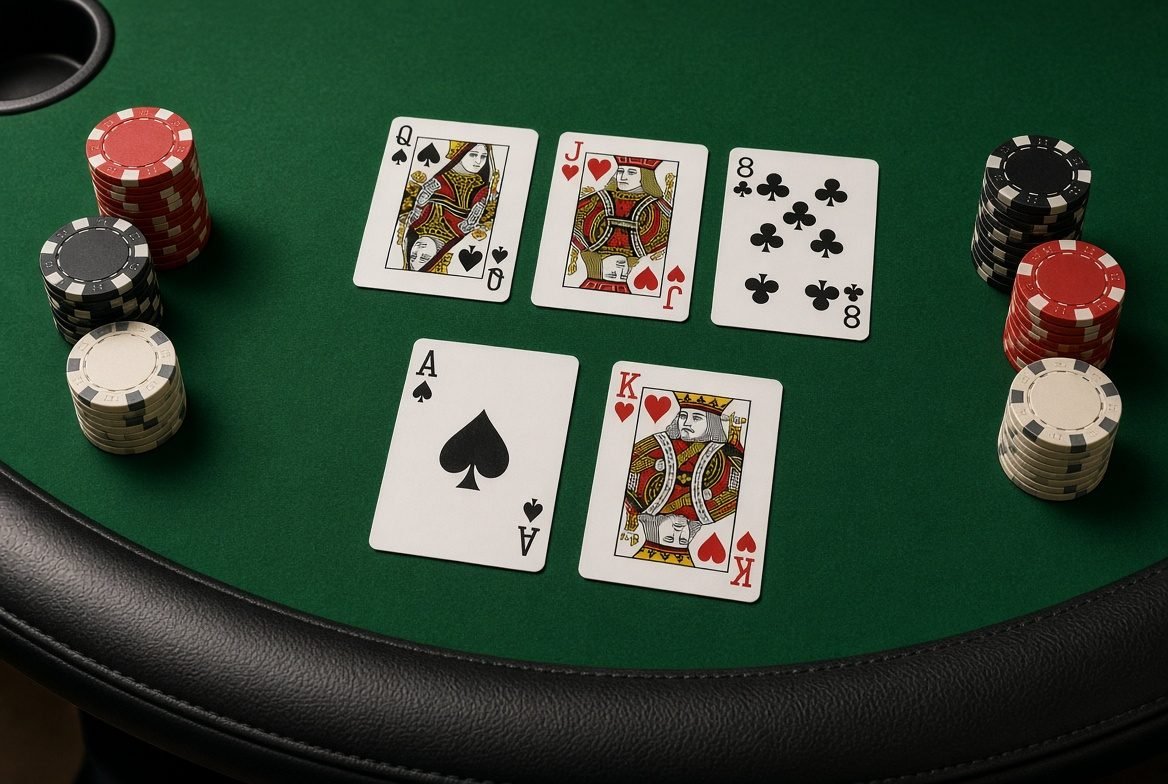
Six-handed cash table. Blinds $1/$2. You are on the button with Ace of spades and King of hearts. Everyone has $200.
You are dealt two hole cards face down. Nobody else sees them. Fold, call $2, or raise.
Under-the-gun folds. Hijack folds. Cutoff raises to $6. You are on the button. Ace-King is a raising hand, not a calling hand, in this spot. You make it $18. Small blind folds. Big blind folds. Cutoff calls. Pot is $39.
That decision is preflop basics and starting hands, not magic.
Three community cards come at once. You missed a pair. You do have two overcards (Ace and King beat Queen) and a gutshot to a Broadway straight if a Ten comes.
Cutoff checks. You can check and see a cheap turn, or bet. A small bet here also charges draws. You bet $20. Cutoff calls. Pot $79.
The Four of diamonds changes almost nothing. No flush completed. Your straight still needs a Ten. Cutoff checks. You check back. Pot stays $79. Checking is allowed when nobody has bet yet this street. See betting actions.
Ten of clubs. You made Ace-King-Queen-Jack-Ten — a Broadway straight. That beats a pair of Queens and two pair. It loses only to hands that are not possible on this board texture.
Cutoff bets $40. You raise to $110. Cutoff calls. Showdown.
You table Ace-King. Five-card hand: A-K-Q-J-T. Cutoff tables Queen-Jack of diamonds — two pair, Queens and Jacks. Your straight wins. You do not need both hole cards as a rule; you need the best five. You may use one hole card, both, or the board alone. That is in the showdown rules.
A player who bets or raises can win earlier if everyone folds. You do not always reach showdown.
Going all-in is betting or raising your remaining chips. Definition: all-in.
On the flop in the worked hand you had a gutshot plus overcards. You do not need the exact percentage on day one. You do need the idea: the price of a call versus the chance you improve. That is pot odds. Check a number with the pot odds calculator.
More of that list: common beginner mistakes.
Two private, up to five public. Best five-card hand wins at showdown.
No. One, both, or the board alone.
Preflop: left of the big blind. Later streets: left of the button, among players still in.
Yes. If everyone else folds, the pot is yours.
Full house, four of a kind, straight flush, royal flush.
Same rules for how a hand is played. Different prize pool. Format guide: Double Up Sit and Go.
The list above, with kickers and ties.
Read →Why the button is worth more than first-to-act.
Read →Price of a call versus chance of improving.
Read →Poker costs money. Limits come before volume.
Read →Last updated: 6 September 2026 · Editor: Greg Parsons · Educational only. No strategy guarantees profit.